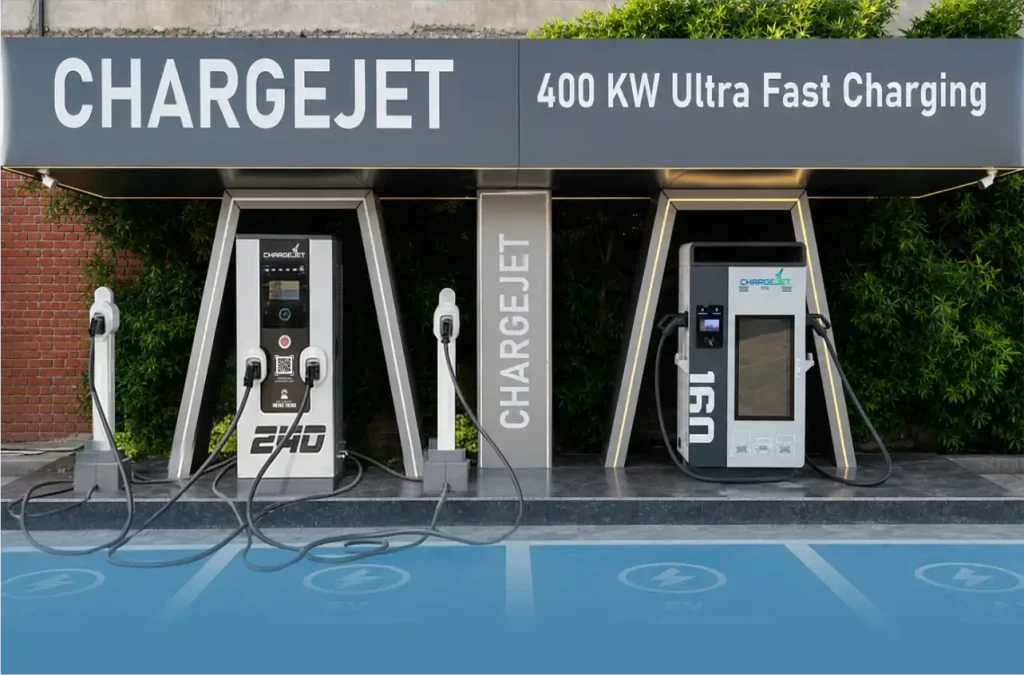
Picture the scene. You’re somewhere on a Rajasthan highway, your battery’s sitting at 22%, and there’s a ChargeJet station coming up at the next fuel stop. You pull in, connect the charging gun, hold your phone up to the QR code on the unit, pay through whichever UPI app you already use every day, and the session starts.
No app store. No account creation. No pre-loaded wallet you topped up six months ago and forgot about. The whole thing takes less time than ordering a chai.
That’s not a product demo. That’s what ChargeJet’s new App-Free Charging feature actually does, live across its network, right now.
Sounds simple Yes. It is and that’s entirely the point. But getting EV charging to feel this effortless has taken a genuine rethink of what public charging infrastructure should actually ask of the people using it.
The frustration nobody wants to admit
India’s EV story has been genuinely impressive. Government programmes like PM E-DRIVE (which replaced the earlier FAME scheme in late 2024) have pushed charging infrastructure buildout past 27,000 public stations, registrations crossed 2.5 million in FY2025-26, a 24% jump over the previous year, and the conversation around electric mobility has gone from niche to mainstream. All good.
But spend time talking to EV owners who actually rely on public charging, and a quiet frustration keeps surfacing one that has nothing to do with the vehicles themselves.
Here’s what using a typical public charging network in India looks like: you arrive at a station, realise you need a specific app to use it, open the App Store or Play Store, wait for it to download, fill in your details, verify your account, load money into yet another dedicated wallet, and then at last start charging.
If it’s a network you haven’t used before, you’re doing all of this from scratch. If your battery is already low, you’re doing it with one eye on the percentage display and a rising sense of dread.
For seasoned EV owners, it’s a minor annoyance they’ve learned to pre-empt. For someone using a public charger for the very first time? It can be enough to put them off entirely and drive straight back to whatever home charging setup they have. And for fleet drivers managing electric vehicles across multiple cities, juggling separate app accounts for five different charging networks is an administrative headache that erodes the very cost benefits fleet electrification was supposed to deliver.
The issue isn’t that charging apps are badly built. Some are quite good. The issue is that requiring a dedicated application as the entry point to basic public infrastructure is the wrong design decision and EV charging has been making it for years.
Connect. Scan. Pay. Go.
ChargeJet’s solution is almost aggressively straightforward.
You connect the charging gun to your vehicle. You scan the QR code on the unit with your phone’s camera no particular app needed, just your camera. A payment page opens in your browser, you pay through Google Pay, PhonePe, Paytm, BHIM, or whichever UPI app you already use for everything else, and charging starts the moment the payment confirms.
That’s it. No new account. No identity forms. No minimum balance to track. No app using up space on your phone for the eleven months a year you’re not near that particular network’s station.
What’s clever here is less about what the feature does and more about what it removes. EV charging has accumulated layers of process over the years, some for legitimate security reasons, some out of habit, some because platforms wanted users locked into their ecosystem. Strip away everything that isn’t essential to the actual act of charging a vehicle, and you’re left with something very close to what ChargeJet has built.
QR-based UPI Payments – India already knows how to do this
Here’s the thing about QR-based UPI payments: India didn’t just adopt them. India absolutely mastered them.
Hundreds of millions of people now pay for everything this way groceries at the kirana store, street food, autorickshaw rides, petrol, temple donations. The scan-and-pay habit is embedded so deeply across age groups and income levels that it’s essentially frictionless. It doesn’t feel like using technology anymore; it just feels like paying for something.
ChargeJet is essentially asking EV drivers to do exactly what they already do dozens of times a week. Same phone, same UPI app, same muscle memory. The only difference is that this time, the QR code is on a charging station instead of a shop counter.
That’s a much smaller ask than “download our app, create an account, and load a wallet balance.” And for India at this particular moment in its EV journey, the size of that ask matters enormously.
The early wave of EV buyers engineers, tech enthusiasts, people who read charging network reviews before they buy a car these folks will sign up for an app without blinking. But that’s not who India needs to win over next. The next wave of EV buyers are ordinary people who want their car to be electric but don’t want their daily routine to feel complicated. Meeting them where they already are, payment-habit-wise, is exactly the right move.
What the founder actually believes
Anirudh Krishan Vaishnav, who founded ChargeJet in Jaipur, has a view of EV infrastructure that goes beyond station counts and kilowatt outputs. His argument, essentially, is that a charger that’s technically functional but practically difficult to use isn’t actually good infrastructure. It just looks like it on paper.
“At ChargeJet, we believe EV charging should be as simple as making a digital payment. Our App-Free Charging feature removes unnecessary steps and allows users to start charging instantly. This innovation is aimed at making charging infrastructure more accessible and improving the overall EV ownership experience across India,” he said at the launch.
There’s something worth sitting with in that framing. Indians make UPI payments billions of times a month. The trust is there. The habit is there. The speed is there. ChargeJet isn’t asking people to learn a new behaviour, it’s plugging into one that already works, and applying it to something new. That’s a different philosophy from most charging networks, which have built their user experience around keeping customers inside a proprietary ecosystem.
Vaishnav was also direct about who this matters most for. “The future of EV charging lies in simplicity and accessibility. By eliminating the need for app downloads, we are reducing barriers for first-time users and making public charging easier for every EV owner.”
First-time users are worth emphasising. Your first experience of public EV charging shapes how you feel about public EV charging for a long time. A smooth, five-second session start is a very different first impression from fifteen minutes of form-filling on a forecourt.
Who does this actually help?
Honestly, most EV drivers benefit in some way but the impact lands differently depending on how you use your car.
If you’re a regular EV owner doing mostly urban driving with occasional longer trips, the main benefit is freedom. You can use any ChargeJet station you happen to pass without needing to have set anything up beforehand. Spotted a charger on a road you don’t usually take? Use it, right now, without any prep.
If you drive highways regularly, it’s bigger than that. Long-distance EV driving already involves enough mental load monitoring your battery, planning stops, adjusting for traffic. The last thing you need at the charging station is a software onboarding process. App-free charging means a highway stop is genuinely a two-minute pause, not a twenty-minute ordeal.
For fleet operators, the practical difference is even more tangible. Running ten electric vehicles across three cities with drivers who may never have used a particular network before is a logistical puzzle. App-free charging with UPI payment means each driver can charge at any ChargeJet station independently, with every transaction automatically documented in their payment history. No shared accounts, no reimbursement disputes, no driver calling in to ask why the charging app won’t load.
And for EV owners in Tier 2 and Tier 3 cities where EV growth has actually been strong, and where digital payments are widely used but platform-specific apps are less reliably familiar this feature doesn’t just reduce friction. It removes a genuine barrier to using public infrastructure at all.
A network worth using
App-free charging is most useful when the charger it’s attached to actually works. Worth mentioning, then, that ChargeJet operates across 25+ cities and 20+ major highways, with a charging range from 20 kW to 720 kW and 100+ active charging points backed by AI-powered real-time monitoring. The company claims 99% uptime — which, against a national average charger downtime of around 18%, is the kind of number that actually changes how you plan a journey.
A seamless payment experience connected to a charger that’s offline is just a faster way to be disappointed. The uptime figure matters as much as the feature.
The app-free charging feature is now live across ChargeJet’s network.
The bigger picture
India needs an estimated 1.32 million public charging stations by 2030 to hit its 30% EV penetration target, more than 40 times today’s installed base of roughly 29,000.
PM E-DRIVE is putting 22,100 new DC fast chargers into the pipeline for cars alone, on top of separate allocations for buses and two/three-wheelers. These are significant commitments, but execution has historically lagged sanctioning.
As of March 2026, PM E-DRIVE’s charging outlay had seen zero expenditure, and FAME-II’s own chargers only reached about 71% operational status. If the pipeline is actually delivered this time, it’ll reshape EV ownership in this country.
But coverage on a map and usability in real life are two different things. All those chargers will only deliver their full value if the experience of using them is accessible to the full range of people who own EVs in India — not just the technically comfortable, not just frequent users who’ve already downloaded every charging app going, but the driver on their first highway trip in an electric car who just needs to top up without a tutorial.
ChargeJet’s app-free charging is a small answer to a large question. And its core argument that the best infrastructure improvements sometimes mean removing things rather than adding them is one the broader industry could stand to hear.
Paying for fuel has never required a dedicated app. Neither should charging your car.
Frequently Asked Questions
Do I actually need to download anything?
No. Your phone’s camera and any UPI app you already use are all you need. There’s no ChargeJet app required.
Which UPI apps work?
All of them: Google Pay, PhonePe, Paytm, BHIM, your bank’s UPI app. If it can make a UPI payment, it works at a ChargeJet station.
Do I need to register an account first?
No registration, no account, no onboarding. Scan, pay, and charging begins.
Is it available at all ChargeJet stations?
Yes, the feature has launched across the ChargeJet network. You’ll see the QR code on the charging unit.
What if I prefer using an app?
That option still exists. App-free is an addition, not a replacement, so regular app users won’t notice any change.
Is a QR-based payment secure?
Yes. It runs on standard UPI infrastructure with bank-grade security and two-factor authentication. The station itself doesn’t hold any payment credentials.